
Think about the last time you needed a car service, an emergency electrician, an independent dentist, or a specialist commercial contractor. You almost certainly did not consult a printed business directory or wait for a flyer to drop through your letterbox. You opened Google on your phone or laptop and typed what you needed followed by your town or the phrase "near me."
Your prospective customers are executing that exact search every single day in Swindon, Wiltshire, and throughout the UK. The fundamental commercial question is simple: when they search for the exact services you provide, do they discover your business, or are they directed straight to your competitors?
Acquiring local customers through Google is not an unpredictable lottery. It is a systematic process governed by well-defined search engine algorithms. In this practical guide, we break down the key interconnected pillars you need to master to dominate local search, generate high-intent inbound calls, and turn Google into your most reliable new business generator.
Pillar 1: Master Your Google Business Profile (The Local 3-Pack)
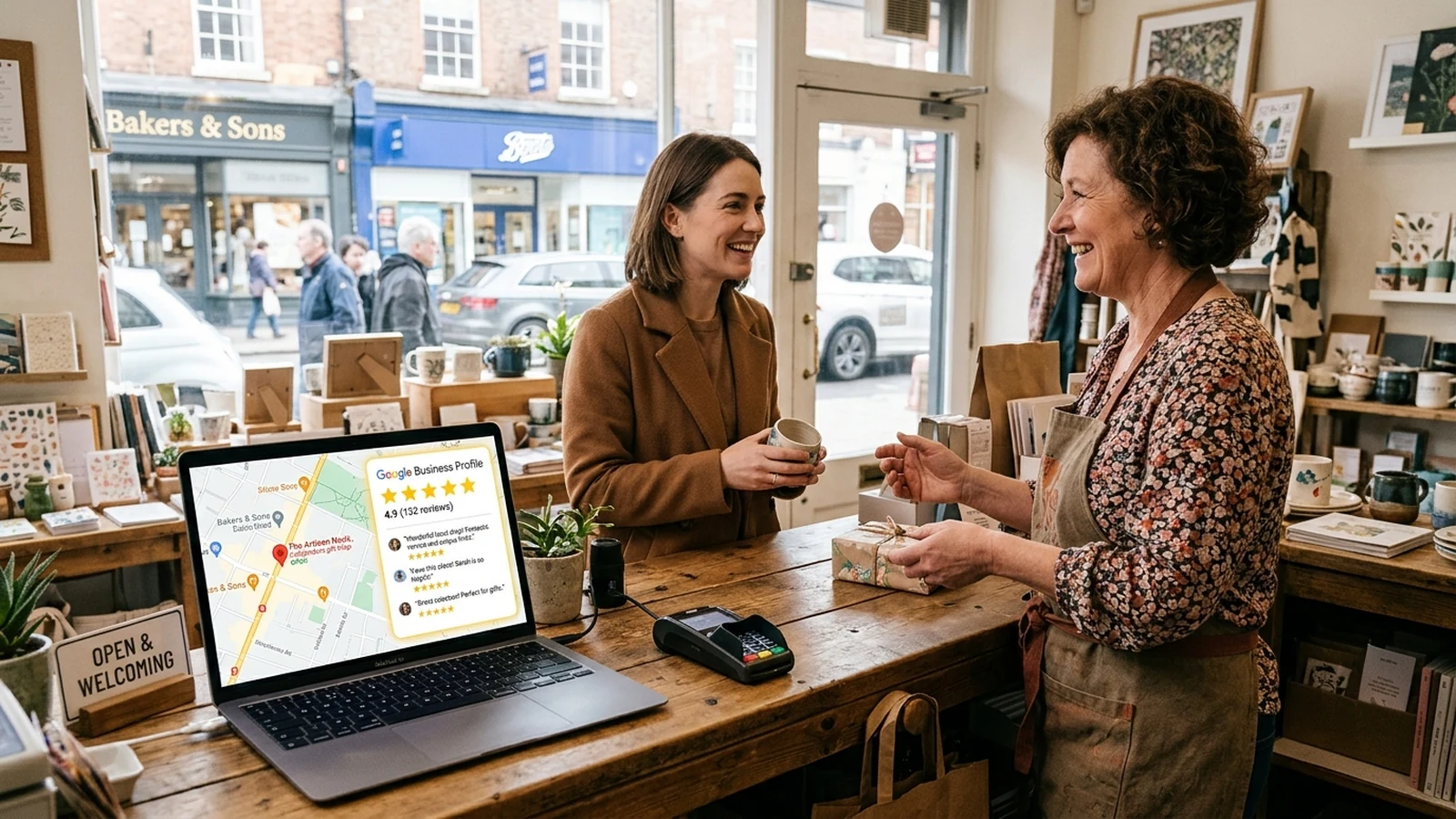
For local businesses, the Google Map Pack (the interactive map box featuring three highlighted local companies) captures between 40% and 60% of all local clicks. Securing a spot in this 3-pack requires an active, meticulously maintained Google Business Profile (GBP):
- Primary Category Accuracy: Your primary category carries immense algorithmic weight. Be precise. If you are a commercial heating engineer, choose that specific classification rather than a generic "contractor" category.
- Comprehensive Service Listings: Populate every single service you offer with descriptive text and transparent pricing where feasible. This feeds Google’s semantic understanding of your business scope.
- Authentic High-Resolution Photography: Upload genuine photos of your team at work, your branded vehicles, completed local projects, and premises. Businesses with rich photographic portfolios receive 42% more requests for directions.
- Weekly Google Updates (Posts): Treat your profile like an active noticeboard. Post weekly updates showcasing recent work, seasonal guidance, or company milestones to demonstrate active operational presence.
For a detailed step-by-step walkthrough, explore our dedicated guide on how to improve your Google Business Profile.
Pillar 2: Manage Seasonal Hours and Public Bank Holidays Proactively
In the UK, public bank holidays (from May Bank Holidays to Easter and Christmas) represent peak periods of customer search activity. When a consumer searches for a service during a holiday weekend, Google prominently displays flags such as "Holiday hours may differ" if the owner has not confirmed their schedule.
If your competitors confirm their holiday hours while your profile remains ambiguous, Google will prioritize the verified listing to protect user experience. Take two minutes ahead of every UK bank holiday to update your special opening hours inside your profile dashboard. It signals active management and avoids frustrating customers who travel to a closed premises.
Pillar 3: Build Localised Service Landing Pages That Convert
A common mistake among small business owners is attempting to make a single homepage rank for ten different services across five different towns. Google prefers specificity.
To capture local commercial search queries effectively, your website structure should include dedicated landing pages:
- Dedicated Service Pages: Create distinct pages for each core offering (e.g. domestic rewiring, commercial lighting, electrical testing) rather than a bulleted list on one page.
- Targeted Geographic Context: If your company operates across Swindon, Marlborough, Royal Wootton Bassett, and Cirencester, build targeted location landing pages that address each community’s unique local requirements.
- Prominent Above-the-Fold Calls to Action: Ensure mobile visitors can tap to call or click to message on WhatsApp without having to scroll through paragraphs of introductory text.
A purpose-built website structure developed through our website design solutions provides the necessary architecture for targeted local ranking.
Pillar 4: The Systematic Review Acquisition Engine
Client reviews represent the single most powerful dual-purpose marketing asset in local business. They simultaneously boost your Google search rankings and dissolve customer hesitation.
Why Review Velocity Outweighs Sheer Review Count
Google's algorithm does not simply evaluate who has the highest total number of stars. It measures Review Velocity and Recency. A business that gathers three thoughtful, authentic reviews every month will consistently outrank a competitor that accumulated forty reviews three years ago and has received none since.
To build an enduring review engine:
- Automate the Request Timing: Send a polite WhatsApp message or SMS containing a direct Google review link within 24 to 48 hours of successfully completing a job.
- Guide the Content Gently: Encourage clients to mention the specific service provided and the town in which the work took place (e.g. "We loved the kitchen renovation CONEXXUS carried out in Swindon"). Google indexes these review keywords!
- Respond to Every Review: Craft unique, polite responses to both positive and critical feedback, reiterating your commitment to local customer satisfaction.
Pillar 5: Ironclad NAP Consistency Across UK Citations
Google verifies the physical legitimacy of your business by comparing its NAP details (Name, Address, Phone Number) across independent web directories.
If your address is listed as "Suite 4, High Street" on your website, but "4 High St" on Yell and an outdated former address on Scoot, search engines experience data uncertainty. When Google is uncertain, it lowers your ranking confidence.
Conduct an audit of primary UK business directories and ensure:
- Your trading name matches your legal identity across all platforms without artificial keyword stuffing.
- Your telephone number uses a local landline area code or standard UK mobile format consistently.
- Your business website URL uses the modern clean protocol without trailing slashes or obsolete extensions.
Pillar 6: Implement LocalBusiness Schema Markup
Schema markup is structured code placed in the head of your website that communicates directly with search engine robots in their native language (JSON-LD).
By embedding standard LocalBusiness schema, you explicitly confirm:
- Your exact geographic coordinates (latitude and longitude).
- Your weekly trading hours and seasonal bank holiday variations.
- Your customer service email and telephone contact points.
- Links to your verified social media profiles and Google Maps entity.
Combining technical schema with targeted on-page copy forms the core of our Local SEO services, providing the technical edge needed to surpass competitors in organic search results.
Local Hyper-Context: Engaging with Wiltshire Communities
Search engines are becoming remarkably sophisticated at understanding regional context. In addition to directory listings, Google looks for mentions of your business on local community websites, local sports club sponsorships, charitable initiatives, and regional Wiltshire business networks.
When local regional publications or community portals link back to your service pages, search engines register a powerful signal of genuine community integration. This regional authority cements your position in the local Map Pack and protects your rankings against competitors attempting to rank from distant towns without genuine local roots.
Want More Local Enquiries from Google?
Transform your Google presence from a neglected listing into an active customer acquisition channel. CONEXXUS helps small UK businesses rank higher on Google Maps and search results.
Frequently Asked Questions
What is the fastest way for a small business to get local customers on Google?
The single fastest organic channel is claiming, verifying, and fully populating your Google Business Profile. When combined with consistent five-star customer reviews, your business can start appearing in the Google Map Pack for nearby searches within a few weeks.
How crucial is my physical address for Google Maps rankings?
Proximity to the searcher is one of Google's primary local ranking signals. If you serve multiple towns from one location, creating dedicated local landing pages for secondary towns helps bridge geographic distance.
Can service-area businesses without a physical shopfront rank on Google?
Yes. If you operate as a mobile trade or consultant without a public commercial premises, you can configure your profile as a 'Service Area Business' (SAB), hiding your home street address while specifying the exact postcodes and regions you serve.
How should I respond to an unfair or negative Google review?
Respond promptly, calmly, and professionally. Acknowledge the feedback, express a sincere desire to investigate offline, and provide direct contact details. Prospective customers judge your professionalism based on how graciously you handle criticism.
How do duplicate citations or conflicting addresses harm my Google visibility?
When search engines encounter conflicting telephone numbers or old trading addresses across UK directories like Yell, Thomson Local, or Scoot, it triggers algorithmic data uncertainty. Google suppresses your Map Pack ranking until data records are cleaned and aligned into one uniform profile.