
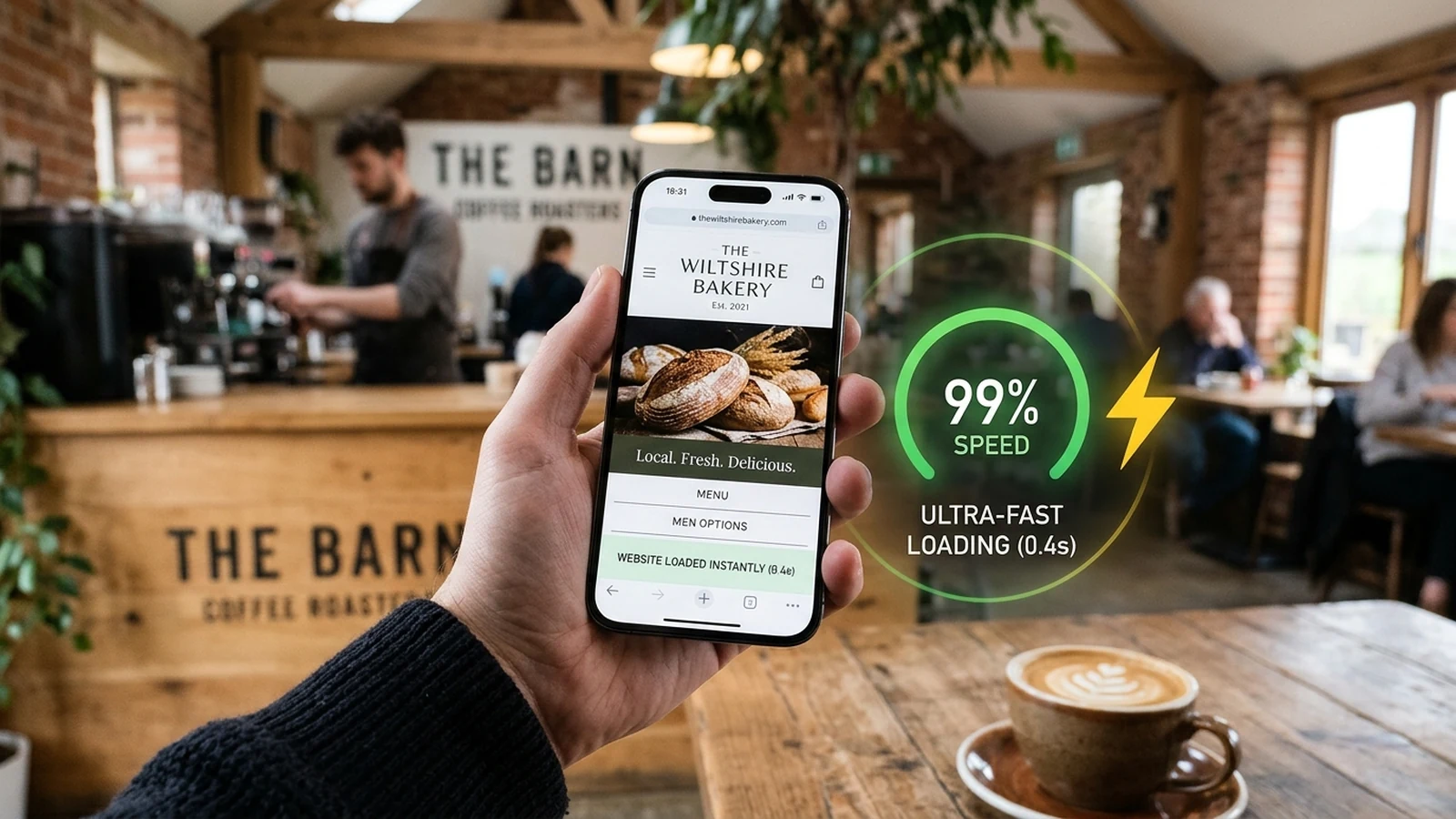
Picture this everyday British scenario: a prospective customer is walking through Swindon town centre, waiting for a train at Swindon railway station, or sitting in their vehicle outside a property needing urgent assistance. They pull out their smartphone, search for a local service on Google, and tap on your website.
One second passes. The screen remains entirely blank.
Two seconds pass. A partial header stutters into view, only to jump abruptly downward as a heavy promotional banner loads late.
Three seconds pass. Before the body text even becomes readable, the user has tapped the back button and selected the very next listing on the search results page. In the span of three seconds, you lost a potential £500, £2,000, or £10,000 customer—and you will never even know they visited.
In the modern UK marketplace, mobile website speed is no longer a technical vanity metric reserved for Silicon Valley tech giants. It is the single most critical gatekeeper of your company's revenue, conversion rate, and local Google visibility.
The Brutal Economics of Mobile Latency
Consumer tolerance for slow digital experiences has completely collapsed over the past decade. Google’s extensive consumer behavioural research demonstrates a direct, unforgiving correlation between page load speed and bounce rates:
- As page load time increases from 1 second to 3 seconds, the probability of a bounce increases by 32%.
- As page load time increases from 1 second to 5 seconds, bounce probability surges by 90%.
- At 10 seconds, the probability of abandonment surpasses 123%.
For an independent business in Swindon, Wiltshire, or the South West, this means a slow website functions like a locked shop door. You may have invested in beautiful branding, pristine photography, and competitive pricing, but if the door takes five seconds to open, customers simply walk down the high street to someone else.
Google's Core Web Vitals in Plain English
Google evaluates website performance through a framework known as Core Web Vitals. While the technical acronyms can appear daunting, the concepts reflect common-sense human experiences:
1. Largest Contentful Paint (LCP) — "How fast does it appear?"
LCP measures the time it takes for the largest visual element on the screen—usually your main hero image, headline, or introductory statement—to render completely.
- Target: Under 2.5 seconds on standard mobile 4G.
- Why it matters: If LCP takes longer, the user perceives the website as broken or sluggish and leaves.
2. Interaction to Next Paint (INP) — "How responsive is it to my touch?"
INP evaluates how swiftly your page reacts when a user taps the mobile menu button, expands an FAQ accordion, or clicks a telephone link.
- Target: Under 200 milliseconds.
- Why it matters: Nothing irritates mobile users more than tapping a button and experiencing a delayed freeze while the browser processes bloated background code.
3. Cumulative Layout Shift (CLS) — "Does the page jump around?"
CLS measures visual stability. Have you ever tried to tap a button on your phone, only for the page to jump suddenly because an unoptimized image finished loading, causing you to tap the wrong link?
- Target: Score below 0.1.
- Why it matters: Erratic layout shifts destroy user confidence and trigger immediate frustration.
Mobile-First Indexing: Google Does Not Care About Your Desktop Site
Since 2019, Google has operated strictly under Mobile-First Indexing. This means Google’s search algorithms evaluate, index, and rank your website based exclusively on how it performs on a simulated mid-tier mobile smartphone over a standard cellular connection.
It does not matter if your website looks flawless on a 27-inch 4K desktop monitor connected to ultra-fast fibre broadband. If it chokes on a smartphone on a 4G connection, your Google rankings will suffer across all devices.
The Real-World Testing Blindspot: 4G Cellular Latency vs Office Wi-Fi
One of the most dangerous traps small business owners fall into is testing their website exclusively on their high-speed office or home broadband. When you sit at your desk on a 500Mbps fibre connection, virtually any website loads tolerably fast.
However, your prospective clients are rarely browsing under laboratory conditions. They are accessing your site:
- Inside commercial retail parks or industrial estates with congested 4G signal.
- Whilst travelling across rural Wiltshire roads where coverage fluctuates between 3G and 4G.
- On older smartphones that struggle to execute megabytes of unminified JavaScript.
When Google evaluates your site speed, it throttles the test environment to simulate these exact real-world cellular constraints. If your platform is bloated with complex scripts and raw photographs, it will stall completely on real consumer devices.
Voice Search and Mobile Assistants: Speed Dictates the Winner
Local search behaviour is increasingly driven by conversational voice queries through Apple Siri, Google Assistant, and in-car systems. A driver asking, "Hey Siri, find an emergency mechanic near me," does not wait for a search results page to scroll through.
Voice assistants demand near-instantaneous data retrieval. Search engine engines query structured local schema and lightweight websites to extract immediate answers. If your website takes four seconds to respond, automated voice systems bypass your listing entirely and recommend a competitor whose website delivers instantaneous data.
Why Small Business Websites Become Sluggish
Most small business websites do not start out deliberately slow. Sluggishness creeps in through well-intentioned but technically undisciplined decisions:
- Uncompressed Photographic Assets: Uploading 5MB raw camera photos directly from smartphones rather than compressing them into modern 16:9 WebP formats.
- Bloated Off-the-Shelf Themes: Generic WordPress themes designed to suit every possible industry come pre-packaged with megabytes of unused CSS animations and complex scripts.
- Plugin Proliferation: Installing a separate plugin for every minor feature—social share bars, tracking scripts, form builders, sliders—each injecting additional HTTP requests that delay page rendering.
- Cheap Shared Hosting: Hosting your commercial platform on bargain £2/month shared servers that throttle CPU resources during peak visitor hours, as explored in our guide on why quality website hosting matters.
How Mobile Speed Directly Drives Local Conversions
Speed is not merely an SEO ranking signal; it is an active sales conversion mechanism. When your website loads instantaneously, three powerful things happen:
- Effortless Tap-to-Call Actions: Mobile users looking for a local service want direct access. An instantaneous page puts your telephone and WhatsApp buttons directly into their thumb zone without waiting.
- Reduced Form Abandonment: A quote form that opens crisply and validates user input smoothly converts at up to twice the rate of a laggy, stuttering form.
- Instant Credibility: A fast website creates a subconscious association with competence, reliability, and modern efficiency. If your website is slow and broken, prospective clients assume your operational service will be equally sluggish.
To see how streamlined, responsive architecture converts visitors into enquiries, browse our recent client case studies in our creative portfolio.
Five Practical Steps to Accelerate Your Mobile Website Today
You do not need an advanced computer science degree to dramatically improve your mobile website speed. Start with these high-impact measures:
1. Convert Images to Next-Gen WebP
Replace legacy PNG and JPEG files with modern WebP images. WebP delivers equivalent visual fidelity with 30% to 70% smaller file sizes, drastically cutting mobile data consumption.
2. Implement Aggressive Browser Caching
Configure your server (.htaccess) to instruct visiting browsers to store static files locally. When visitors return to your site, pages load almost instantaneously from their device memory.
3. Eliminate Non-Essential JavaScript
Audit your third-party scripts. Remove obsolete tracking pixels, turn off decorative animations that add zero commercial value, and defer remaining scripts until after main content renders.
4. Move to Clean, Semantic Foundations
If your site is weighed down by years of layered plugins, transitioning to a bespoke, cleanly coded semantic structure through our website design services delivers permanent, lightweight speed.
Is Your Website Too Slow for Mobile Users?
Do not let poor mobile loading speeds cost you valuable local clients. Let the CONEXXUS team audit your site's Core Web Vitals and build an ultra-fast platform engineered to rank and convert.
Frequently Asked Questions
What is a good Google PageSpeed Insights score for a local business?
A score of 85 or above on mobile is considered excellent for a commercial small business website. More important than the arbitrary score itself is achieving green 'Good' thresholds for Core Web Vitals (LCP under 2.5 seconds, INP under 200ms, and CLS under 0.1).
Does mobile speed still matter if my business serves local clients offline?
Crucially so. Over 70% of local consumers search on mobile devices before ever visiting a physical premises or calling a trade professional. A slow site causes immediate bounce, sending prospective clients straight to your local competitor.
Why are WordPress websites frequently slow on mobile devices?
WordPress sites slow down when loaded with multi-purpose commercial themes, unoptimised large images, page builders that inject excess DOM elements, and numerous third-party plugins executing conflicting JavaScript on page load.
Will improving mobile speed alone push my website to rank #1?
Mobile speed is an essential technical ranking factor and a critical prerequisite for conversions, but it must be paired with authoritative local content, schema markup, and an active Google Business Profile to secure top search rankings.
Does image compression degrade photo quality on high-resolution Retina smartphone screens?
Not with modern WebP encoding. Properly formatted WebP images retain pristine visual clarity, colour depth, and sharpness on modern iPhone and Android Retina displays while dramatically shrinking file weight by up to 70% compared to legacy PNG and JPEG files.