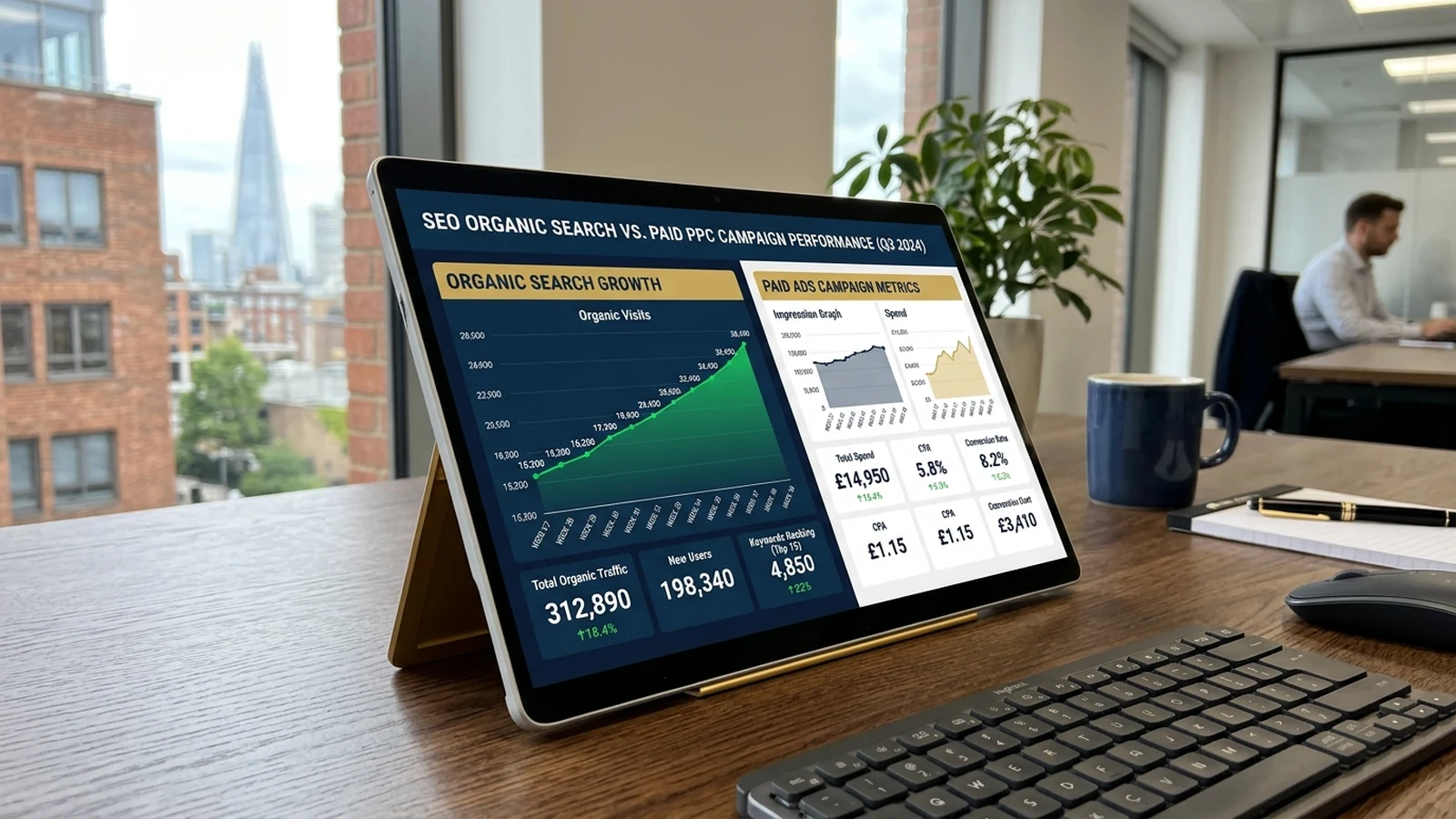
For small business owners across the United Kingdom, investing in digital growth often leads to a familiar crossroads: should you invest your hard-earned marketing budget into Search Engine Optimisation (SEO), or should you allocate your capital directly into Google Ads pay-per-click (PPC) campaigns?
Ask three different digital marketers and you will likely receive three conflicting answers. An SEO specialist will insist that paying for clicks is a never-ending financial treadmill. A pay-per-click consultant will argue that organic search takes far too long and lacks predictable control. Meanwhile, business owners in Swindon, Wiltshire, and throughout the UK simply want to know one thing: which channel delivers the highest return on investment for our commercial goals?
The truth is that neither channel is inherently superior. Each serves a distinct commercial purpose, carries its own cost structure, and addresses customer intent in a unique way. In this comprehensive guide, we examine the practical mechanics, financial realities, and strategic trade-offs of SEO versus Google Ads for small UK enterprises.
Understanding Google Ads: Speed, Precision, and Immediate Visibility
Google Ads operates on an auction-based pay-per-click model. When a homeowner searches for an emergency plumber, a commercial solicitor, or an independent accountant, Google displays sponsored advertisements at the absolute top of the search engine results page (SERP), above both the local map pack and organic listings.
You only incur a charge when an interested user actively clicks on your advertisement. The cost per click (CPC) is determined by competition, keyword search volume, and your Quality Score—a metric reflecting the relevance of your ad copy and your target landing page.
The Advantages of Google Ads
- Instant Traffic: A well-structured campaign can be activated this morning and generate qualified inbound enquiries before close of business this afternoon.
- Pinpoint Demographic & Geographic Targeting: You can restrict your advertisements exclusively to specific postal codes (e.g. SN1 to SN6 in Swindon), set operating hours, and target high-intent transactional search queries.
- Valuable Search Term Data: Google Ads provides immediate insight into the exact keyword phrases prospective buyers type before picking up the telephone or completing a quote request.
- Agile Budget Control: You establish a daily budget ceiling (such as £25 or £50 per day), ensuring your expenditure never exceeds your pre-determined comfort zone.
The Limitations of Google Ads
- No Cumulative Asset Value: The moment you pause your campaign or deplete your credit card balance, your traffic drops to zero instantly. You do not own the visibility; you are merely renting shelf space.
- Rising Cost-Per-Click Inflation: In competitive UK sectors such as legal services, commercial roofing, or emergency locksmiths, clicks can range from £8 to £45 each. Without disciplined landing page conversion rates, budgets can evaporate rapidly.
- Ad Blindness & User Scepticism: Extensive consumer studies reveal that between 70% and 80% of UK searchers deliberately bypass sponsored ad units to click on authentic organic results or the Google Maps 3-Pack.
Understanding Organic SEO: Compounding Authority and Sustainable Equity
Organic Search Engine Optimisation (SEO) is the disciplined process of earning high-ranking visibility in Google's natural search results without paying search engines for individual clicks.
SEO encompasses three fundamental pillars:
- Technical SEO: Ensuring your website is fast, secure (HTTPS), cleanly coded, mobile-responsive, and easily crawled by Google’s automated indexers.
- On-Page Optimisation & Content: Crafting authoritative, helpful guides, service pages, and case studies that directly satisfy user search intent.
- Local Authority & Off-Page Signals: Securing authentic citations, building reputable local backlinks, and maintaining a stellar Google Business Profile with genuine customer reviews.
The Advantages of SEO
- Compounding Return on Investment: Unlike paid ads, high organic rankings do not demand ongoing per-click fees. An article or service page published today can continue generating high-value enquiries two or three years into the future.
- Higher User Trust and Conversion Rates: UK consumers instinctively recognise that organic rankings cannot be bought overnight. Appearing organically on page one positions your company as an established, trustworthy leader in your field.
- Dominance Across the Buying Cycle: SEO allows you to capture buyers at every stage of their journey—from initial informational queries to local commercial searches like local SEO services.
- Continuous 24/7 Inbound Generation: Your organic listings never "run out of budget" at 2:00 PM on a Tuesday.
The Limitations of SEO
- Time to Traction: Achieving dominant page-one rankings in competitive local niches generally requires three to six months of persistent, methodical optimisation.
- Algorithmic Evolution: Google updates its core ranking algorithms several times each year, meaning technical compliance and content quality must be consistently maintained.
- Requires Modern Web Architecture: SEO cannot succeed on an outdated, slow platform. You need clean, responsive code and lightning-fast loading speeds, as explained in our bespoke website design frameworks.
Side-by-Side Comparison: SEO vs Google Ads
| Feature | Google Ads (PPC) | Organic SEO |
|---|---|---|
| Speed to Visibility | Immediate (hours/days) | Gradual (3 to 6 months) |
| Cost Structure | Pay per click + management | Fixed monthly retainer or build |
| Click Longevity | Stops immediately when paused | Enduring long-term equity |
| Consumer Click Share | Approximately 15% – 25% | Approximately 70% – 80% |
| Long-Term ROI | Linear (fixed cost per lead) | Exponential (cost per lead drops) |
When Should a Small UK Business Choose Google Ads?
Pay-per-click advertising is the optimal strategic choice in specific commercial scenarios:
- You Are a Brand New Business: If you registered your company last week and have zero existing market presence, waiting six months for organic SEO might strain your immediate cash flow. Google Ads can generate immediate customer phone calls to keep cash moving.
- Time-Sensitive Offers & Events: Seasonal campaigns, special promotions, Black Friday deals, or limited-capacity workshops require an acquisition channel that can be switched on and off instantly.
- High-Margin Urgent Services: Services with acute consumer urgency—such as emergency drainage, 24-hour locksmithing, or storm damage repairs—command extraordinarily high conversion rates from paid search ads because users cannot afford to shop around.
When Should a Small UK Business Choose SEO?
Organic search optimisation is the superior choice when your objective is sustainable, resilient enterprise growth:
- You Want to Build an Enduring Commercial Asset: If you intend to run your business for the next five to ten years, relying solely on rented ad clicks is financially inefficient. SEO creates lasting commercial value that increases your company’s intrinsic worth.
- Your Profit Margins Cannot Bear High CPCs: If your average customer transaction is modest, paying £10 for a click with a 5% conversion rate yields an unsustainable customer acquisition cost of £200. Organic visibility eliminates this margin squeeze.
- You Want to Dominate Local Geography: Optimising your Google Business Profile and local landing pages allows you to capture the map pack across your entire regional radius, as shown in our Google Business Profile optimisation framework.
The Smart Solution: The Hybrid "Flywheel" Strategy
Rather than viewing SEO and Google Ads as mortal adversaries, the most successful small businesses treat them as complementary engines that fuel one another.
In a hybrid strategy, you launch a modest Google Ads campaign initially to test keyword conversions, discover exactly which search terms generate paying enquiries, and fund early cash flow. Simultaneously, you funnel those insights into your organic SEO and content architecture. As your organic rankings climb onto page one and your map pack presence solidifies, you can strategically scale back your paid ad spend on proven keywords—reallocating those savings into higher-margin business activities.
For businesses operating across different markets or exploring international growth, balancing paid acquisition and sustainable organic reach requires an adaptable multi-regional strategy. You can explore how international teams manage these cross-market dynamics through CONEXUS Digital Solutions in Brazil.
Need Help Choosing the Right Growth Strategy?
Do not gamble your marketing budget on guesswork. At CONEXXUS, we assess your industry, budget, and local market competition to build a clear, honest acquisition strategy tailored to your business.
Frequently Asked Questions
How much should a small UK business budget for Google Ads?
Most small independent businesses in the UK allocate between £500 and £1,500 per month for Google Ads click budget, plus management fees. The exact figure depends heavily on industry competition; trades such as emergency locksmiths or roofing command higher cost-per-click rates than boutique consulting.
Can I pause Google Ads once my organic SEO rankings improve?
Yes, that is one of the greatest commercial advantages of organic SEO. While Google Ads traffic stops the precise second you turn off your daily budget, high organic rankings persist, providing continuous inbound leads without ongoing cost-per-click charges.
Why do so many small businesses fail with Google Ads?
Small business owners frequently waste money on Google Ads by targeting broad keywords without negative exclusions, sending traffic to slow, non-responsive homepages rather than dedicated landing pages, or failing to track conversion events accurately.
Is SEO always better than Google Ads in the long run?
Not always. While organic SEO delivers superior long-term ROI and digital equity, Google Ads offers unmatched speed for immediate product launches, seasonal promotions, or businesses needing immediate cash flow while organic visibility matures.